

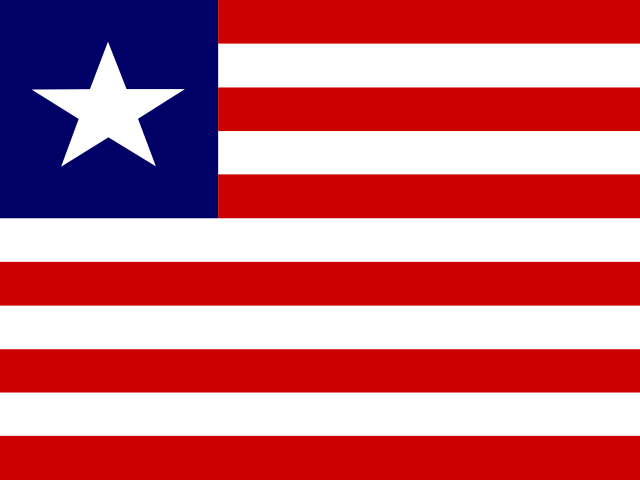
01Key Takeaways
- Liberia exported $153.70 million worth of goods in 2023, down 24.24% from $202.89 million in 2022.
- Rubber led every export category by a wide margin at 63.22% ($97.16 million), tied to one of the world's largest rubber plantations.
- Animal and vegetable fats and oils, mostly palm oil, ranked second at 21.06% ($32.37 million).
- The USA absorbed 37.45% of Liberia's exports, worth $57.56 million, more than any other destination.
025-Year Trend
| Year | 2019 | 2020 | 2021 | 2022 | 2023 |
|---|---|---|---|---|---|
| Value | $271.2M | $418.1M | $171.7M | $202.9M | $153.7M |
03Top Export Markets (2023)
| Rank | Partner | Value | Share |
|---|---|---|---|
| 1 | United States | $57.6M | 37.4% |
| 2 | Belgium | $32.9M | 21.4% |
| 3 | Cameroon | $10.6M | 6.9% |
| 4 | Ghana | $7.5M | 4.9% |
| 5 | Singapore | $6.8M | 4.4% |
| 6 | United Kingdom | $4.5M | 2.9% |
| 7 | Malaysia | $3.9M | 2.6% |
| 8 | United Arab Emirates | $3.8M | 2.4% |
| 9 | Spain | $3.2M | 2.1% |
| 10 | Morocco | $2.7M | 1.8% |
04Top Export Categories (2023)
| Rank | Category | Value | Share |
|---|---|---|---|
| 1 | Rubber and Articles thereof | $97.2M | 63.2% |
| 2 | Animal or Vegetable Fats and Oils and their Cleavage Products; Prepared Edible Fats; Animal or Vegetable Waxes | $32.4M | 21.1% |
| 3 | Nuclear Reactors, Boilers, Machinery and Mechanical Appliances; Parts thereof | $5.7M | 3.7% |
| 4 | Cocoa and Cocoa Preparations | $4.1M | 2.7% |
| 5 | Mineral Fuels, Mineral Oils and Products of their Distillation; Bituminous Substances; Mineral Waxes | $2.8M | 1.8% |
| 6 | Soap, Organic Surface-Active Agents, Washing Preparations, Lubricating Preparations, Artificial Waxes, Prepared Waxes, Polishing or Scouring Preparations, Candles and similar Articles, Modelling Pastes, Dental Waxes and Dental Preparations with a basis of Plaster | $2.5M | 1.6% |
| 7 | Articles of Iron or Steel | $1.8M | 1.2% |
| 8 | Wood and Articles of Wood; Wood Charcoal | $1.6M | 1.0% |
| 9 | Toys, Games and Sports Requisites; Parts and Accessories thereof | $1.4M | 0.9% |
| 10 | Vehicles other than Railway or Tramway Rolling-Stock, and parts and accessories thereof | $1.2M | 0.8% |
05Trade Partner Map
06Analysis
Rubber Still Defines Liberia's Export Economy
Liberia exported $153.70 million worth of goods in 2023, down 24.24% from $202.89 million in 2022. Rubber and articles thereof topped every category by a wide margin at 63.22% of the total, worth $97.16 million. A single rubber operation, leased across roughly 220 square miles of Liberian land since the 1920s, has functioned as the country's largest private employer and largest exporter for nearly a century. That plantation still ships raw and processed rubber abroad for use in tires and other manufactured goods, a legacy that keeps this one category dominant even as the rest of Liberia's export base stays small and fragmented. Smallholder farmers around the country also grow and tap rubber trees outside the concession itself, selling latex into the same export supply chain, though the concession remains by far the largest single source of production. Few countries anywhere depend this heavily on one crop for the majority of their export earnings.
Animal, vegetable and microbial fats and oils, largely palm oil, ranked a distant second at 21.06% ($32.37 million). Sime Darby, Golden Veroleum and Equatorial Palm Oil together hold concessions spanning nearly two million acres, just under 10% of Liberia's total land mass. Environmental standards tied to European market access have limited how much of that concession land companies can actually convert to production, and long-running community land disputes have slowed development further still. Machinery added 3.69% ($5.68 million), a small but steady category reflecting equipment purchases for plantation operations and general industry alike. Cocoa and cocoa preparations contributed 2.70% ($4.14 million), a modest but notable entry given Liberia's relatively limited history as a cocoa exporter compared with its West African neighbors. Mineral fuels supplied 1.84% ($2.83 million), and soap and waxes added 1.61% ($2.48 million). Iron or steel articles contributed 1.16% ($1.78 million), wood and charcoal added 1.01% ($1.55 million), toys and games supplied 0.93% ($1.43 million), and vehicles closed out the top ten at 0.76% ($1.16 million).
The US Buys More Rubber Than Any Other Market
United States absorbed 37.45% of Liberia's exports in 2023, worth $57.56 million, more than any other destination, a share that traces back to decades of rubber shipped from Liberia's plantations into the American tire industry. Belgium ranked second at 21.43% ($32.94 million), a figure that sits almost exactly in line with the value of Liberia's fats-and-oils exports, pointing to Belgium's role as a major buyer of Liberian palm oil bound for European processors. Cameroon took third at 6.88% ($10.58 million), and Ghana added 4.91% ($7.55 million), both regional destinations reflecting West African trade ties. Together, these top three markets made up 65.76% of total export value.
Singapore supplied 4.42% ($6.79 million), and United Kingdom added 2.95% ($4.53 million). Malaysia contributed 2.57% ($3.95 million), and United Arab Emirates supplied 2.45% ($3.76 million). Spain added 2.05% ($3.15 million), and Morocco closed out the top ten at 1.75% ($2.69 million). That spread of smaller Asian, European and North African buyers fills out the remainder of a list otherwise dominated by the USA and Belgium.
A Pandemic-Era Spike Has Given Way to Three Years of Decline
Liberia's export total has swung sharply over the past five years. It stood at $271.17 million in 2019, then jumped to $418.06 million in 2020, the high point of the five-year window, before crashing to $171.67 million in 2021. It has kept falling since, easing to $202.89 million in 2022 and $153.70 million in 2023.
That 2020 spike lines up with a global surge in rubber demand tied to the pandemic, when soaring orders for surgical gloves and other rubber products pushed prices to multi-year highs before easing back as glove demand normalized in the years that followed. US natural rubber prices kept depreciating through 2023 as weak demand from China, rising global production, and an import glut weighed on the market, even as production volumes themselves increased. A country whose export total depends this heavily on a single agricultural commodity will keep tracking that commodity's price cycle more closely than any change in domestic policy. Palm oil adds a second layer of exposure on top of rubber, since its own output depends on concession development timelines and environmental approvals that move independently of anything happening in the rubber market. Until Liberia's export base broadens beyond these two commodities, its trade totals will likely keep swinging with global agricultural cycles rather than settling into a steadier trend.